Is ETMY Radio Equipment Worth the Price? An Honest Breakdown

Is Professional Radio Equipment Really Worth the Price?
You've found the radio you need. The specs look right. But then you see the price — and you pause.
Is this actually worth it? Am I paying for real engineering, or just a brand name?
It's a fair question. The two-way radio market ranges from $20 consumer walkie-talkies to $500+ enterprise-grade digital systems — and the difference isn't always obvious from the outside. At ETMY, we believe every price tag should be explainable. So let's explain ours.
What Actually Drives the Price of Professional Radio Equipment?
Before comparing price tags, it helps to understand what you're actually paying for. Here are the factors that separate a $40 radio from a $400 one:
- Build quality & durability: IP67/IP68 waterproofing, rugged housings, and military-grade materials cost more to engineer — but they dramatically extend the lifespan of the device in harsh field conditions.
- Frequency & power output: Higher wattage (e.g., 8W VHF / 12W UHF) means greater range. More frequency bands mean more versatility across job sites, facilities, and regions.
- Digital vs. analog: DMR digital radios deliver clearer audio, AES encryption, and advanced features like GPS tracking and remote kill — capabilities that analog simply cannot match.
- Network technology: 4G PoC (Push-to-Talk over Cellular) radios operate over cellular networks, eliminating range limits entirely. The hardware and software behind this justifies a higher price point — and replaces far more expensive infrastructure.
- Certifications & compliance: Radios built to ETSI standards, with AES256 encryption or explosion-proof ratings, undergo rigorous third-party testing. That process has a cost — and it protects your team.
ETMY Pricing: What You Actually Get at Every Tier
Here's an honest look at how ETMY structures its lineup — and what justifies each price point.
Entry Level — ETMY ET-99 ($39.99) | Best for: Hospitality, Small Teams, First-Time Buyers
The ET-99 proves that professional communication doesn't have to be expensive. For under $40, you get a 16-channel UHF radio with a 1500mAh battery, CTCSS/DCS squelch support, and 5V USB charging. It's slim, lightweight, and ready to deploy out of the box.
Who uses it: Hotel front desk teams, event staff, small retail operations, and anyone coordinating across short distances who needs reliability without complexity.
At this price, the ET-99 isn't just accurate — it's exceptional value.
Mid Range — ETMY ET-D330 ($299.99) | Best for: Field Operations, Construction, Security
The ET-D330 is an IP67-rated DMR digital radio with 10W output power, Type-C fast charging, VOX voice activation, one-click emergency alarm, and built-in voice recording. It competes directly with radios priced $100–$200 higher from other brands.
Who uses it: Construction site supervisors, warehouse managers, and security teams who need durability, range, and digital clarity in demanding environments.
At $299.99, this radio is arguably underpriced for what it delivers.
Professional Grade — ETMY ET-D50 (from $325.99) | Best for: Enterprise, Security Operations, Logistics
The ET-D50 is ETMY's flagship DMR digital radio: IP68 waterproof, AES256 encrypted, AMBE+2™ vocoder, dual-mode digital/analog, remote kill/resurrection, and emergency alarm. It doesn't compromise — and neither should the teams that depend on it.
Who uses it: Large-scale security deployments, logistics fleets, and enterprise operations where communication failure is not an option.
The pricing reflects the engineering, certifications, and field-tested reliability behind every unit.
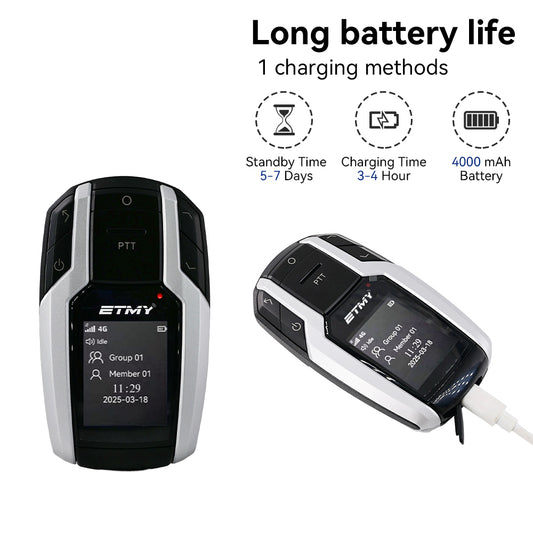
Network Radios — ETMY ET-C11 & ET-C18 (from $119) | Best for: Nationwide & Multi-Site Operations
4G PoC network radios operate over cellular coverage — no repeaters, no tower licenses, no frequency coordination. The ET-C11 and ET-C18 deliver nationwide (even global) communication starting at $159 per device.
Who uses it: Multi-location businesses, transportation companies, and teams that need to stay connected across cities or borders without building out traditional radio infrastructure.
Compare that to the cost of a conventional repeater network — the value becomes immediately clear.
How to Evaluate Any Radio's Price (Use This Checklist)
Before deciding whether a price is fair, run through these questions:
- What is the IP rating? (IP67/IP68 = higher upfront cost, significantly longer lifespan)
- What is the output power? (Higher wattage = more range, fewer dead zones)
- Is it digital or analog? (Digital = clearer audio, encryption, advanced features)
- Does it include GPS, VOX, or emergency functions? (These add real operational value)
- What certifications does it carry? (ETSI, AES256, explosion-proof = tested and verified)
- What's the warranty and after-sales support like?
When you run this checklist against ETMY products, the pricing holds up — and in most cases, you'll find you're getting more than you paid for.
The Verdict: Yes, ETMY Pricing Is Accurate
Every price in the ETMY lineup is backed by real specifications, tested durability, and features that professional teams actually use in the field. Whether you're equipping a small hospitality team with ET-99s or deploying a fleet of ET-D50s for enterprise security, you're getting honest value at every tier.
Still not sure which radio fits your budget and operation? Browse the full ETMY lineup and compare specs side by side — or reach out to our team for a personalized recommendation. We're confident the numbers speak for themselves.